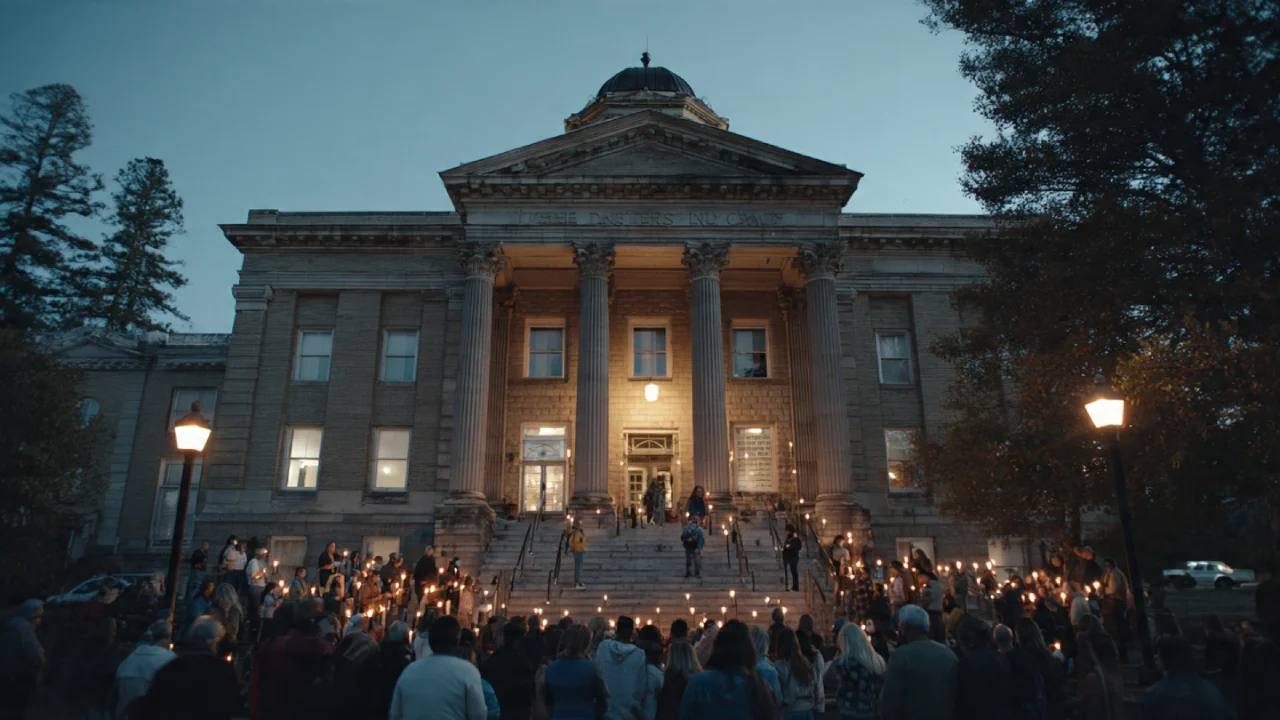
Twenty-five years. That is how long a family waited for answers. That is how long a killer walked free. And now, in a packed Athens-Clarke County courtroom, the Edrick Faust trial verdict hangs in the balance, leaving an entire community holding its breath.
The Weight of 25 Years: Athens Watches and Waits
You might remember January 19, 2001, differently depending on who you were in Athens. Perhaps you were a University of Georgia student walking to class. Maybe you were a resident of the quiet Deer Park neighborhood. Or you could have been part of the law school community, mourning the loss of one of your brightest first-year students. Tara Baker was just 23 years old when someone entered her home, assaulted her, stabbed her, strangled her, and set her bed on fire.
For two decades, the case gathered dust. Then, in 2024, advanced DNA testing changed everything. Now, as the jury deliberates the Edrick Faust trial verdict, you are witnessing history unfold in real time. This is not just a trial. It is a referendum on justice delayed, on forensic science, and on whether a community can finally heal.
Table: Case at a Glance
| Element | Details |
|---|---|
| Defendant | Edrick Lamont Faust, 50 |
| Victim | Tara Louise Baker, 23 |
| Date of Crime | January 19, 2001 |
| Location | Deer Park neighborhood, Athens, Georgia |
| Charges | 12 counts including malice murder, felony murder, rape, aggravated sodomy, arson |
| Trial Start | February 2026 |
| Jury Deliberations | Began Monday, February 16, 2026 |
| Key Evidence | DNA match (1 in 800 quadrillion odds) |
| Prosecution | Western Circuit District Attorney’s Office |
| Defense | Attorney Ahmad R. Crews |
Who Was Tara Baker?
Before you can understand why this Edrick Faust trial verdict matters so deeply to Athens, you need to know who was taken.
Tara Louise Baker grew up in a small town, dreaming big. She earned her spot at the University of Georgia School of Law, one of the most respected institutions in the South. Friends described her as driven, compassionate, and full of promise. She wanted to use her legal education to help others, to make a difference in a world that often felt unfair.
On that January morning in 2001, she was simply living her life. She got up. She started her routine. And then violence shattered everything.
When firefighters responded to the blaze at her apartment, they found a scene of horror. Tara had been stabbed in the neck with such force that her jugular vein was severed. A computer printer cord was wrapped around her neck. She had suffered blunt force trauma to her head. Evidence showed she had been sexually assaulted. The fire, investigators determined, was arson, set to cover the killer’s tracks.
For years, the case haunted Athens. Who could do such a thing? Why Tara? The questions piled up, but answers remained elusive.
The Arrest That Changed Everything
You probably remember where you were when you heard the news in May 2024. After 23 years, Athens-Clarke County Police announced they had made an arrest. Edrick Faust, then 48 years old, was charged with Tara Baker’s murder.
The breakthrough came from science. Investigators had preserved evidence from the original crime scene, including a sexual assault kit. In 2023, they resubmitted that kit for testing using modern DNA extraction methods that did not exist in 2001. A California laboratory processed the samples. What they found was staggering: a DNA profile that matched Faust.
The odds of it being someone else? One in 800 quadrillion.
Faust lived just 585 feet from Tara’s home at the time of the murder. He was 26 years old then, living in a house that had belonged to his stepmother on Cooper Road. To the outside world, he was just another neighbor. But to investigators, he became the prime suspect in a crime that had defined a generation of Athens law enforcement.
Inside the Courtroom: What You Missed
The trial began in February 2026, and for ten days, Athens watched as the past was exhumed. If you followed the proceedings, you saw a case built on circumstantial evidence but anchored by that powerful DNA link.
The Prosecution’s Case
Western Circuit District Attorney Kalki Yalamanchili and Assistant District Attorney Kris Bolden presented a narrative of cold, calculated violence. They walked the jury through Tara’s final moments, describing how Faust allegedly caught her during her morning routine.
“On January 19th of 2001, Tara Baker was taken out of this world,” Yalamanchili told the jury. “Her life extinguished by the defendant in this case, Edrick Lamont Faust.”
The prosecution emphasized the DNA evidence above all else. They called GBI Crime Lab forensic scientist Ashley Hinkle, who testified that TrueAllele software analysis identified Faust as a “major contributor” of DNA found on Tara’s body. They played portions of Faust’s May 2024 GBI interview, where agents confronted him with the DNA match.
“Help us understand why your DNA is in that house,” an agent asked in the recorded interview.
Faust could not explain it. He became animated, using his hands as he spoke more loudly. He claimed he had no reason to go into Deer Park, that he only knew about the case from newspaper stories.
The Defense’s Counter
Attorney Ahmad R. Crews took a different approach. He did not need to prove who killed Tara Baker. He only needed to create reasonable doubt about whether it was Faust.
Crews hammered on the limitations of the investigation. No fingerprints. No footprints. No eyewitnesses placing Faust inside the apartment. He questioned the chain of custody for DNA samples stored for over two decades. He suggested degradation could have compromised the evidence.
Most controversially, Crews pointed fingers at Chris Melton, Tara’s boyfriend at the time of her death. Melton’s DNA was also found on Tara’s body, which the defense argued was expected given their relationship. But Crews showed the jury photos of Melton’s hands taken days after the murder, appearing red and bruised. He suggested the couple’s relationship was ending, creating motive.
Melton testified in his own defense. “I always believed that the truth would set me free,” he said. “I had nothing to hide.” Investigators testified they verified Melton’s alibi and eliminated him as a suspect. He has never been charged.
Athens Reacts: A Community Divided and United
As you walk through Athens today, you feel the weight of this trial everywhere. It is in the conversations at coffee shops near campus. It is in the somber faces of law school faculty who remember Tara. It is in the frustration of those who wonder why it took so long.
The Baker Family’s Long Wait
Virginia Baker, Tara’s mother, has waited 25 years for this moment. She has attended every day of the trial, sitting in the gallery as attorneys described her daughter’s final moments in graphic detail. You can only imagine the strength that requires.
For the Baker family, the Edrick Faust trial verdict represents more than justice. It represents validation that their daughter’s life mattered, that her death was not forgotten, that the system eventually works, even when it takes decades.
The Legal Community’s Response
At the UGA School of Law, Tara’s classmates are now middle-aged professionals. Many have gone on to distinguished careers as prosecutors, defense attorneys, judges. But they have never forgotten the classmate who never got to graduate.
Current law students have followed the trial with a mix of professional interest and personal horror. “This could have been any of us,” one student told a local reporter. “She was just living her life, studying, dreaming. And someone took it all away.”
The trial has become an unintended teaching moment, a real-world example of cold case investigation, DNA evidence, and the challenges of prosecuting decades-old crimes.
Neighborhood Anxiety
In Deer Park, residents who remember 2001 have mixed emotions. Some feel relief that an arrest was made. Others feel uneasy knowing they lived so close to the accused killer for all those years, unaware.
“I walked past that house on Cooper Road a thousand times,” one longtime resident said. “You never know what secrets people are keeping.”
The Science That Made This Possible
You cannot understand the Edrick Faust trial verdict without understanding the technology behind it. This case represents a triumph of forensic science over time.
TrueAllele and DNA Extraction
In 2001, the original rape kit showed no semen or male DNA. The technology of the time simply was not sensitive enough to detect what was there. But evidence was preserved, stored carefully, waiting for science to catch up.
In 2023, investigators sent the kit to a California laboratory specializing in cold case DNA. Using advanced extraction methods, they found genetic material that had been invisible for 22 years. The Georgia Bureau of Investigation Crime Lab then used TrueAllele software, a sophisticated system that can separate mixed DNA samples and identify individual contributors.
The result was definitive. The DNA matched Faust. The statistical probability of it being someone else was so astronomical that it essentially ruled out any other suspect.
The Defense’s Scientific Challenge
Crews tried to undermine this evidence. He questioned the software’s reliability. He suggested the samples had degraded over 20 years in storage. He argued that DNA presence alone does not prove murder, rape, or arson.
But the prosecution countered with testimony about proper chain of custody and the validation of TrueAllele in courts nationwide. They argued that modern science had finally given Tara Baker a voice from beyond the grave.
What the Verdict Means for Cold Cases Nationwide
As you wait for the Edrick Faust trial verdict, consider the broader implications. This case is being watched by law enforcement agencies across the country, by families of other unsolved murder victims, by defense attorneys and prosecutors alike.
A Message to Killers
If Faust is convicted, the message is clear: You cannot outrun DNA. You cannot wait out justice. What you did decades ago can still find you, even if you have built a new life, even if you believe you got away with it.
The success of this investigation will likely spur other agencies to revisit their cold case evidence rooms. Thousands of sexual assault kits sit untested in storage facilities nationwide. Thousands of families wait like the Bakers have waited.
A Warning About Justice Delayed
But the trial also highlights the problems with delayed justice. Memories fade. Evidence degrades. Witnesses become unavailable. The defense has capitalized on these issues, and rightly so. The Constitution guarantees a fair trial, and time is the enemy of fairness.
You must ask yourself: Is a conviction 25 years later truly justice? Or is it merely closure? The answer may depend on whether you believe the system owes more to victims or to the accused.
Key Takeaways: What You Need to Know
As the jury deliberates, here are the essential facts about the Edrick Faust trial verdict:
- DNA is the linchpin: The prosecution’s case rests almost entirely on forensic evidence with astronomical statistical certainty
- No physical evidence: Unlike many murder trials, this one lacks fingerprints, weapons with prints, or eyewitness testimony placing Faust at the scene
- Alternative suspect raised: The defense has focused heavily on Chris Melton, Tara’s boyfriend, though he was never charged and investigators cleared him
- Defendant did not testify: Faust exercised his right to remain silent and did not take the stand in his own defense
- Circumstantial case: Judge Lisa Lott noted this is an “undisputable cold case” based on circumstantial evidence that the jury must weigh
- Community impact: The trial has reopened old wounds in Athens while demonstrating the power of modern forensic science
Frequently Asked Questions
How long did the Edrick Faust trial last?
The trial lasted ten days, with closing arguments on Friday, February 13, 2026. The jury began deliberations on Monday, February 16, 2026.
What charges does Edrick Faust face?
Faust faces 12 charges including malice murder, felony murder, rape, aggravated sodomy, aggravated assault, burglary, and arson.
How was Edrick Faust caught after 23 years?
Advanced DNA testing of evidence from the original 2001 sexual assault kit identified Faust in 2024. The odds of the DNA belonging to someone else were 1 in 800 quadrillion.
Did Edrick Faust testify in his own defense?
No. Faust chose not to take the stand. The jury heard only his recorded statements to GBI agents during his May 2024 interview.
Who was Tara Baker?
Tara Baker was a 23-year-old first-year law student at the University of Georgia. She was found dead in her Deer Park apartment on January 19, 2001, after firefighters responded to an arson fire.
What happens after the verdict?
If convicted, Faust faces life in prison or potentially the death penalty, though Georgia’s death penalty procedures would require additional proceedings. If acquitted, he would walk free, though the DNA match would remain unexplained.
The Verdict Ahead: What Athens Faces
You stand at a crossroads in Athens history. When the jury returns with the Edrick Faust trial verdict, they will deliver more than a decision about one man’s guilt. They will deliver a judgment on 25 years of waiting, on the advances of forensic science, on whether justice delayed is still justice at all.
For the Baker family, whatever the verdict, nothing brings Tara back. But a conviction would say that her life mattered, that her death was not in vain, that the system eventually works. An acquittal would raise questions that may never be answered, leaving a wound open in a community that has already suffered too much.
As you watch this story unfold, remember that behind the legal arguments and scientific evidence is a simple truth: A young woman with dreams and potential had her life stolen. The Edrick Faust trial verdict is Athens’ attempt, 25 years later, to make that right.
Read Also
- Justice Delayed: How Cold Case DNA Is Reshaping Criminal Investigations
- The Science of TrueAllele: Separating DNA in Complex Mixtures
- UGA Law School Remembers Tara Baker
- Athens-Clarke County Cold Case Unit Success Stories
- Tara Baker Murder Trial Verdict: What Happens Next
Disclaimer
This article reports on an ongoing criminal trial. All individuals are presumed innocent until proven guilty in a court of law. The information presented is based on public court records, news reports, and official statements. Verdicts and legal outcomes may change as the judicial process continues. This content is for informational purposes only and does not constitute legal advice.